
How Long Does Marketing Take to Work? A Realistic Timeline for Service Businesses
You signed up. You paid the first invoice.
Now it's week eight and the phone sounds exactly like it did before.
So you start doing the maths. How much longer do I give this?
Most business owners never get a straight answer to that question. They get told to "be patient". Patience doesn't pay wages.
This article gives you real ranges for every major channel, what you should expect at 30, 60, 90 and 180 days, and how to tell a plan that's still warming up from one that's actually broken.
It works the same whether you're a plumber, a painter, a physio or an accountant.
The short version
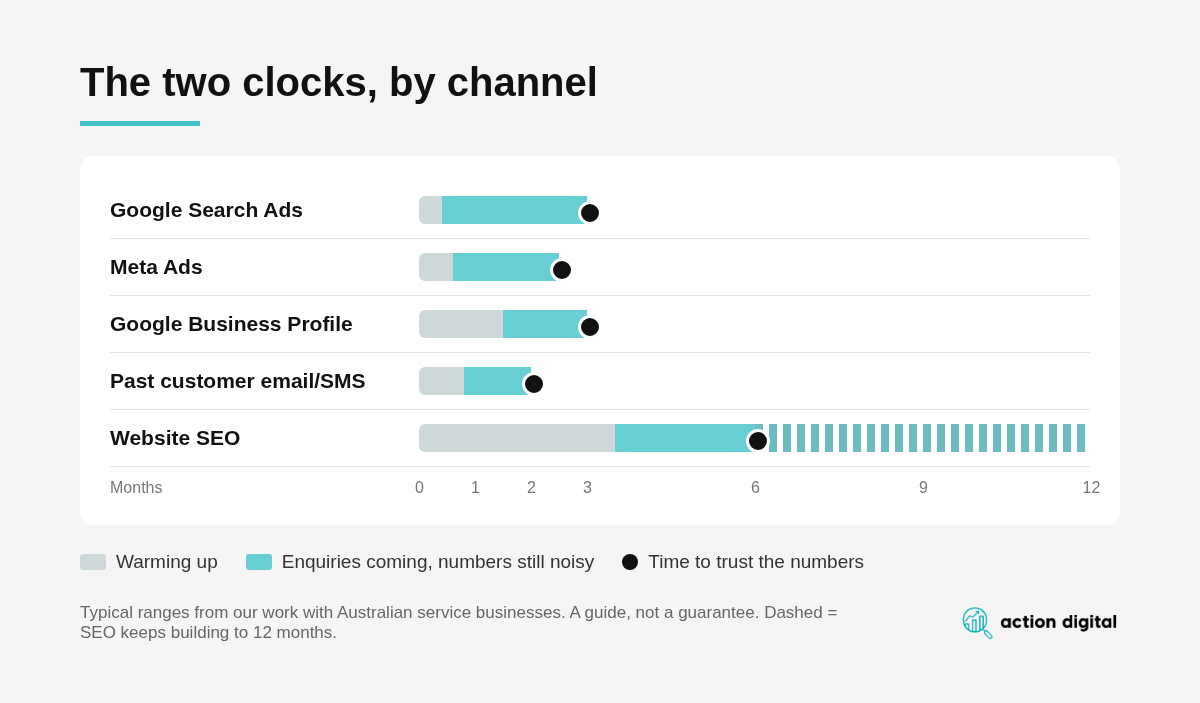
There are two clocks, not one. How long until a channel is live, and how long until its numbers mean anything. They're very different.
Short-term channels buy cash flow. Paid ads can bring enquiries within days.
Long-term channels buy a business that doesn't panic every quiet month. Your Google Business Profile, reviews and website build a foundation that keeps paying.
Most people quit at the worst possible moment. Usually around day 30 to 45, right before the data becomes useful.
Your existing customers are the fastest channel you're probably ignoring.
Slow and broken look alike from the inside. A short list of questions tells them apart.
A quick note on the numbers you'll read online
A lot of marketing timeline advice comes from US agencies, and some of it doesn't hold up here. Three examples:
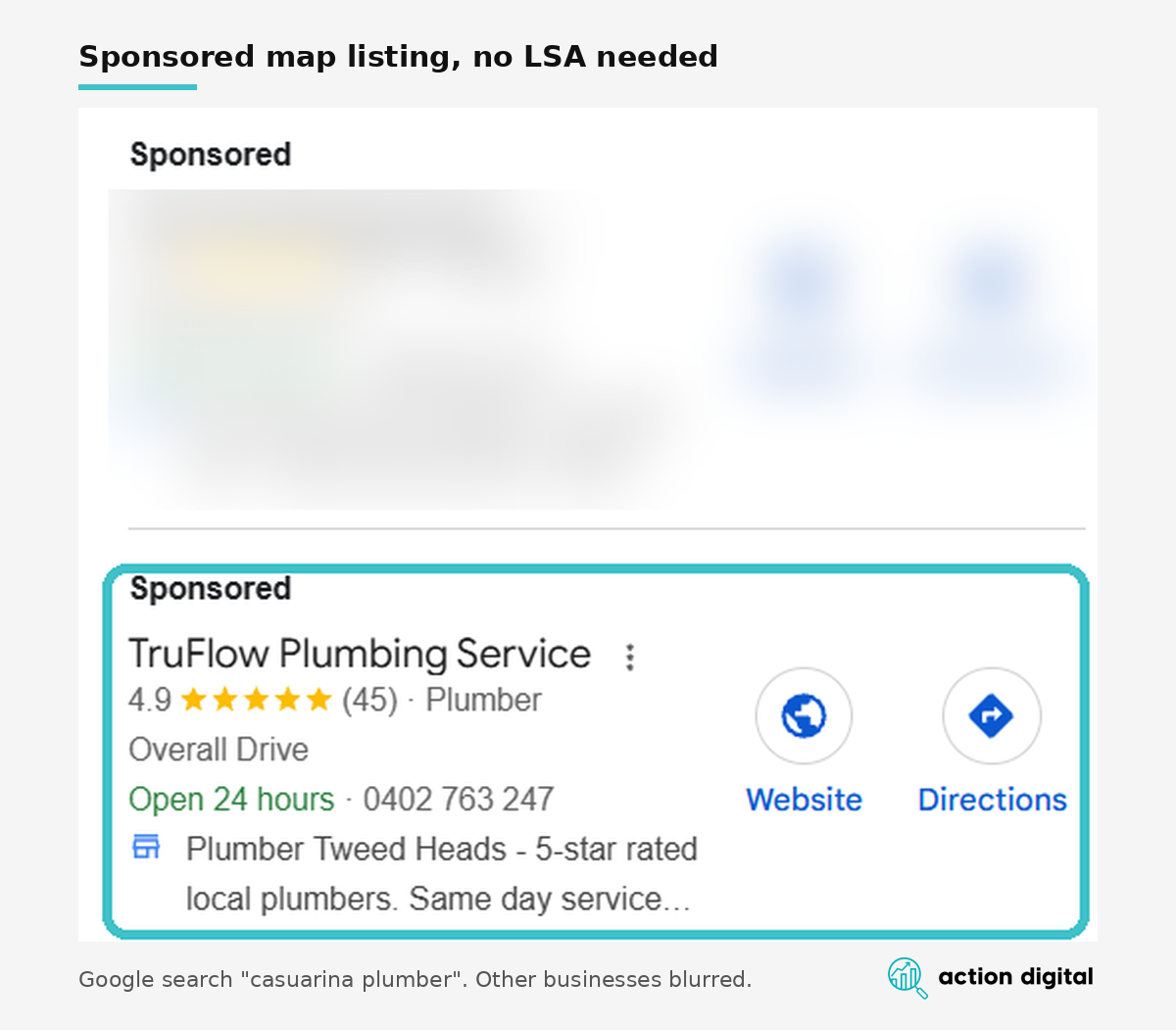
Google Local Services Ads (the "Google Guaranteed" badge) are often described as the fastest lead source. They're not available in Australia. Google's own Local Services Ads help page lists 11 countries, and Australia isn't one of them. The good news: you can get a similar spot another way. Link your Google Business Profile to a Google Search Ads campaign as a location asset and your business can appear as a Sponsored listing at the top of the map results, with your star rating, phone number and hours on show.
"Google says SEO takes four months to a year." That line comes from a 2017 Google video on hiring an SEO, not from Google's current documentation. It's still a sensible range, it's just not an official promise.
"The Google Ads learning period is 90 days." Google says Smart Bidding can take up to three weeks, or one to two conversion cycles, to calibrate. The 90 days is about something else: how long it takes to collect enough jobs to trust your cost per job.
Here's what point 1 looks like in practice. Search "casuarina plumber" and our client TruFlow Plumbing Service appears as a Sponsored listing in the map results, stars, phone number and all. No Local Services Ads required.
The ranges below are from our own experience with Australian service businesses. They're a guide, not a guarantee, and anyone who quotes you exact numbers is guessing.
The timeline by channel
Channel | Time to go live | First enquiries | Time to trust the numbers |
|---|---|---|---|
Google Search Ads | 1 to 2 weeks | A few days to 2 weeks | Around 90 days |
Meta Ads (Facebook and Instagram) | 1 to 2 weeks | 1 to 3 weeks | 60 to 90 days |
Google Business Profile (local SEO) | Days if live, a few weeks if it needs verifying | 4 to 8 weeks | Around 90 days |
Website SEO | 30 to 60 days | 3 to 4 months | 6 to 12 months |
AI search (ChatGPT, Gemini, AI Overviews) | Rides on your GBP and SEO | Follows your GBP and SEO | No published benchmark |
Email and SMS to past customers | 2 to 4 weeks | Days after the first send | Around 60 days |
Those ranges assume three things:
The channel is funded above its minimum.
You send the photos, videos and feedback you're asked for.
Nobody changes the strategy halfway through.
Break any one of those and every timeline stretches.
Why marketing feels slow at the start
Every channel has a warm-up period where you're paying to teach the platform who your customer is.
Google Ads needs conversion data.
Meta needs creative to test.
Search engines need proof your website answers real questions.
Google Maps needs proof you're prominent, which mostly means reviews.
During that window you're buying information, not jobs. It feels awful. It's also unavoidable.
The business that quits at day 45 pays full price for the education and collects none of the return. Then it restarts in spring and pays for the same education again.
Google Search Ads (short term): fast clicks, slow truth
On Google you're paying for intent. Someone typed "emergency electrician near me" because they need one now.
That's why clicks and calls can start within days. But your early cost per enquiry will swing wildly. Week one might look brilliant, week two terrible. Neither tells you much.
Give it around 90 days before you judge cost per booked job. If you can't fund 90 days properly, you're better off putting that money into something else on this list. (Here's how we run Google Ads for service businesses.)
Meta Ads (short term): cheap attention, expensive patience
Nobody opens Facebook looking for a bookkeeper. On Meta you're interrupting people, not answering them. The ad has to create the want that a Google search already has.
That takes creative volume. Real job photos, short video clips, before and afters, your team on site. One ad with two images won't get there. (Our guide to using job photos on social media covers what to capture.)
Expect first enquiries inside three weeks and a settled cost per job between 60 and 90 days.
Judge Meta on booked jobs, not lead count. A campaign that sends 60 cheap leads and books three is losing to one that sends 15 and books six. (More on how we approach Meta Ads.)
Google Business Profile (long term): the fast half of organic
When most people hear "SEO" they picture blog posts and websites. That's the slow half. The fast half is your Google Business Profile and the map results.
Google says it ranks local results on three things: relevance, distance and prominence. Categories, services and profile setup handle relevance. That's done properly once, in the first couple of weeks. (Start with our guide to setting up a new Google Business Profile and our guide to GBP photos.)
Prominence is the part that never stops, and a big part of prominence is reviews. Google confirms review count and rating affect local ranking. In our experience, recent reviews matter too. A profile earning a few new reviews a week can overtake one sitting on 140 reviews from two years ago.
That's what makes this channel fast to start and easy to stall. The setup can be handed off. Asking for reviews at the end of every job can't. (Here's how to reply to Google reviews once they start coming in, and how our reputation management service automates the asking.)
Expect map movement in four to eight weeks.
Expect a fair read on enquiry volume at 90 days.
More on this in how to improve your Google Maps ranking, or see our local SEO service.
Website SEO (long term): the slowest and the most durable
Search compounds, and compounding needs runway. It also needs a site worth ranking: fast, clear and built to turn visitors into calls. If yours isn't there yet, start with website design.
By day 90: pages indexed and small movements in rankings.
Months six to twelve: real organic enquiries.
Year three: the same pages still bringing in work, long after you stopped paying to create them.
That last point is why SEO is worth the wait. Paid ads stop the day you stop paying. Good content keeps working.
AI search (long term): borrows the clocks you already have
More customers now ask ChatGPT or Gemini "who's a good plumber in Tweed Heads?" instead of typing into Google.
AI search doesn't have its own clock. It borrows the two you already have:
The profile and reviews half moves on your Google Business Profile timeline, because AI tools lean on the same local signals.
The content half moves on your SEO timeline, because these tools mostly name businesses that already look established in normal search results.
So the order is profile and reviews first, then content.
There's no ranking report for AI answers. Check it yourself: once a month, ask the tools what your customers would ask and write down whether you come up. After three months you have a trend instead of a feeling.
Your customer list (short term): the channel most businesses ignore
If you've been in business a few years, you're sitting on a list of past customers who already trust you.
A well-timed email or SMS ("it's been two years since we serviced your hot water system") can bring in work within days of sending, at almost no cost per job. Set it up once with email marketing and marketing automation and it keeps running in the background.
What speeds it up, and what kills it
Three things shorten every timeline:
Budget above the floor. A channel funded at half its minimum doesn't run at half speed. It stalls.
Participation. Photos, videos and honest feedback on lead quality. Businesses that send 20 job clips a month beat the ones that send none.
Fast follow-up. Marketing that produces 40 enquiries and books four looks broken. Often it's a missed call or a slow reply. We wrote about this in the jobs you never knew about.
Three things kill every timeline:
Changing direction at day 45.
Switching channels on and off by season.
Judging a whole channel on one bad week.
Slow, or broken? How to tell
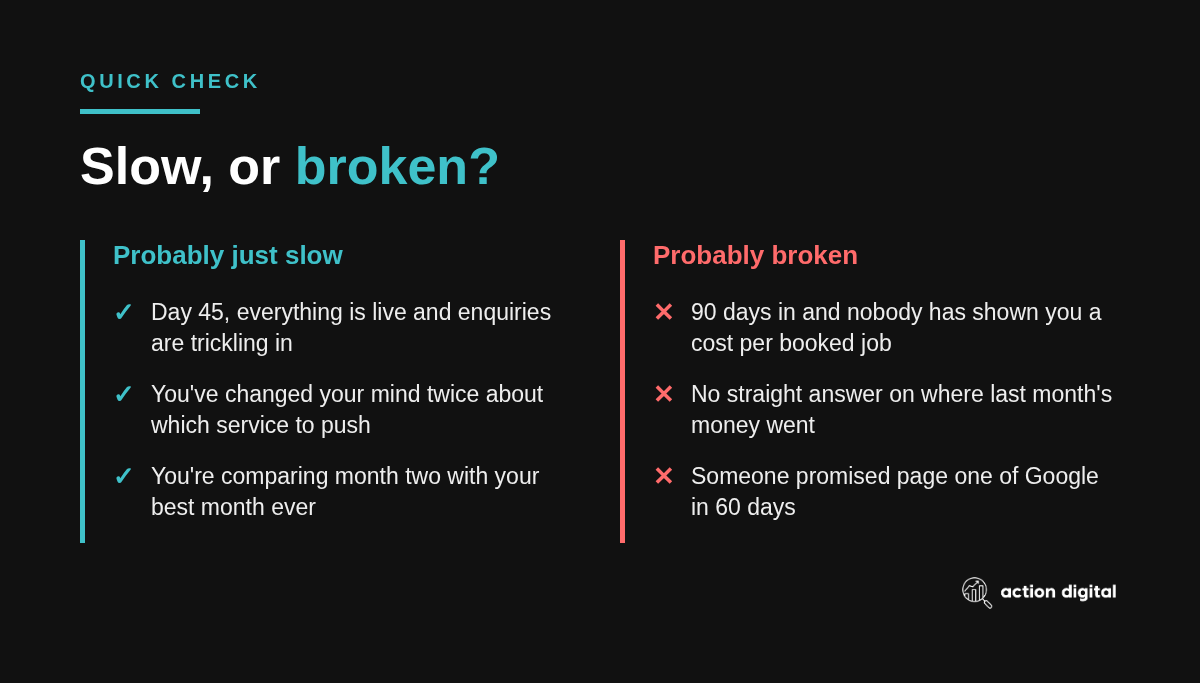
You're probably just being impatient if:
It's day 45, everything is live, reports arrive on time, and enquiries are trickling in.
You've changed your mind twice about which service to push.
You're comparing month two with your best month from three years ago.
Something is probably broken if:
90 days have passed and nobody has shown you a cost per booked job.
You can't get a straight answer about where last month's money went.
Someone promised page one of Google in 60 days. That was never realistic.
You're the only one in the relationship asking questions.
A good partner tells you the timeline before you start, then reports against it whether the news is good or bad.
The bottom line
Short-term channels keep the team busy this quarter. Long-term channels make next year cheaper.
Run only the fast stuff and you rent your leads forever. Run only the slow stuff and you can run out of cash before the payoff arrives.
The businesses that grow fund both, stay involved, and hold their nerve through the ugly bit in the middle.
Want a straight read on where you stand?
We'll look at what you're running now, tell you which channels are still warming up and which are genuinely broken, and show you the timeline you should be on.


