

Your Google Review Replies Are Costing You Jobs. Here's the Fix.
Most Australian service businesses treat Google reviews as a scoreboard. Stars go up, stars go down, and the only time anyone thinks about them is when a bad one lands.
That is the wrong way around. The reviews are written by your customers. The replies are written by you. The reply is the only part of your reputation you fully control, and in 2026 it is being read, judged, and used to decide whether you get the call.
Here is what the research actually says, what Google actually says, and how to run the whole thing in about ten minutes a week.
What the 2026 data says (with sources)
Every number below comes from BrightLocal's Local Consumer Review Survey 2026, a survey of consumers on how they find and judge local businesses.
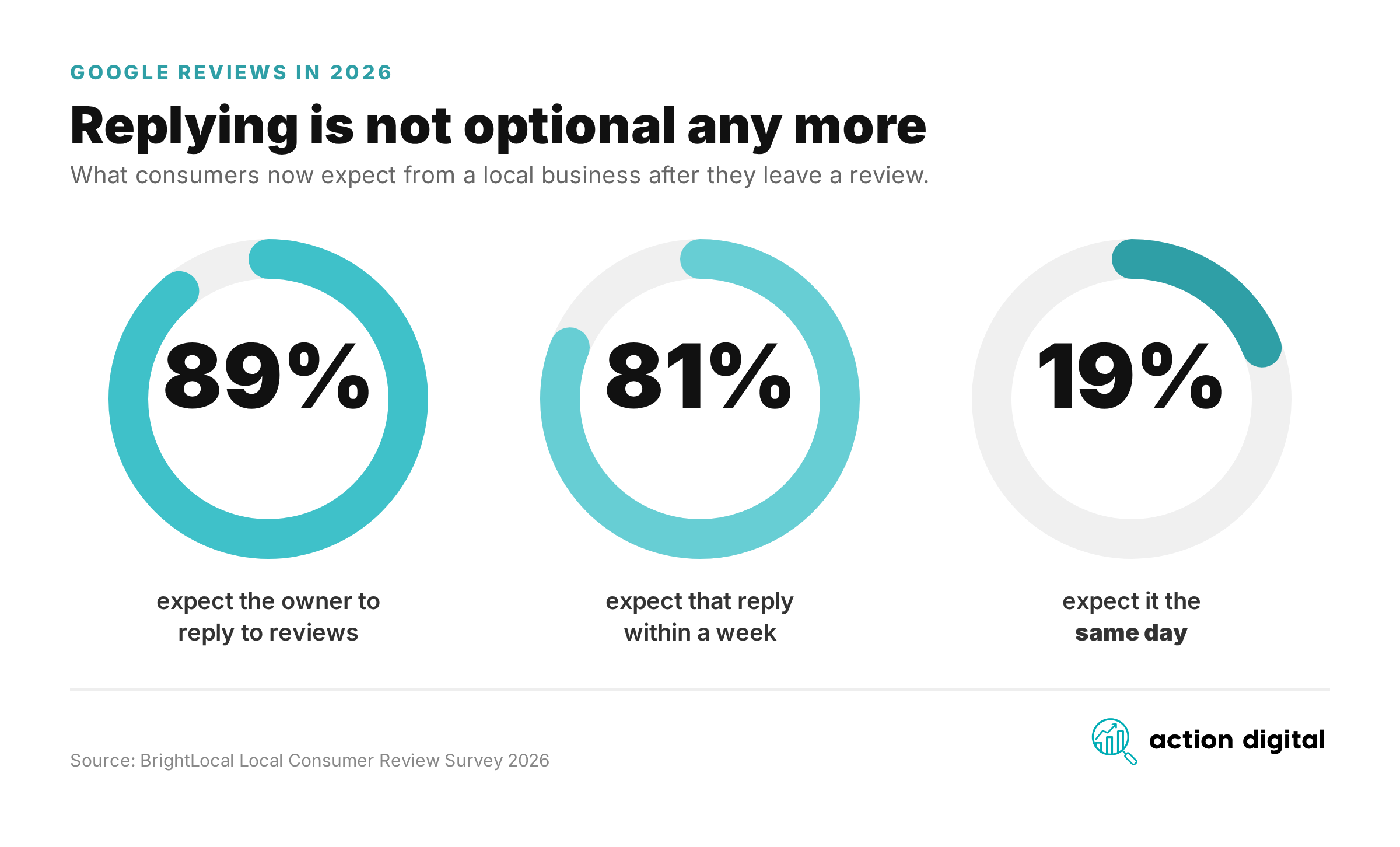
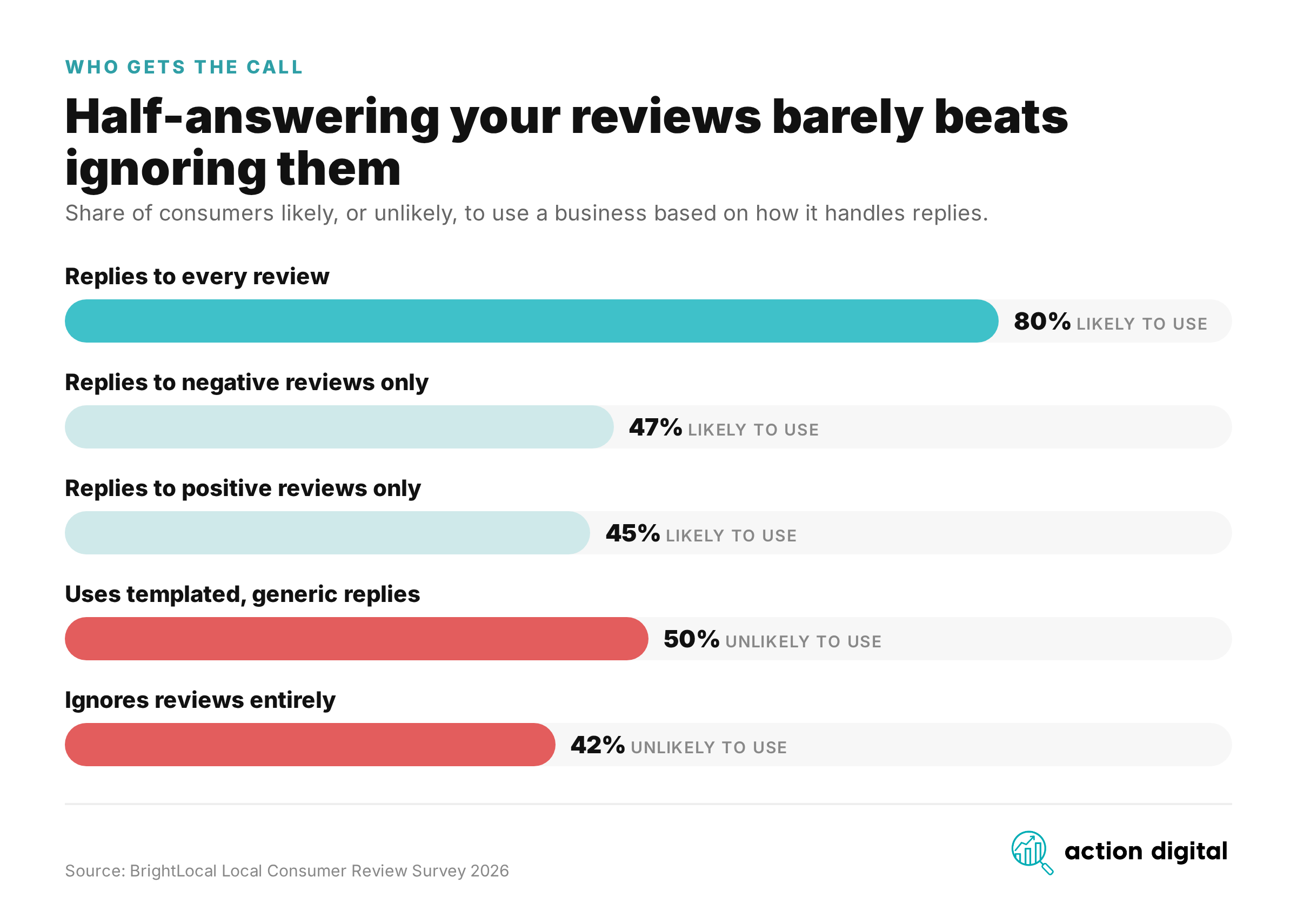
On replies: - 89% of consumers expect business owners to respond to reviews. - 80% say they are likely to use a business that responds to all of its reviews. That drops to 45% for businesses that reply only to positive reviews, and 47% for those that reply only to negative ones. Answering some of your reviews is barely better than answering none. - 42% are unlikely to use a business that ignores its reviews entirely. - 50% are unlikely to choose a business whose replies are templated or generic. This is the number most people miss. A copy-paste "Thanks for your feedback!" under every review is not a neutral act. It actively costs you work. - 81% expect a response within a week, and 19% expect one the same day (up from 6% the year before). - When consumers rank what makes a review trustworthy, "the business owner has responded to the review" comes in at 37%, ahead of things like review length or the reviewer being named.
On getting reviews in the first place: - 97% of consumers read reviews for local businesses, and 41% now always read them when browsing, up from 29% the year before. - 47% will not use a business with fewer than 20 reviews. Only 9% will use one with five or fewer. - 74% only care about reviews written in the last three months. 32% look for reviews from the last two weeks, and 18% only trust reviews from the last week. - 68% will only use a business with four or more stars, up from 55% in 2025. 31% now demand 4.5 or higher. - After reading positive reviews, 54% go to the business's website next, 31% visit in person, and 20% get in touch.
Read those two lists together and the strategy writes itself. A great review from eight months ago is close to invisible. A steady trickle of recent reviews, each one answered like a human wrote it, is what a searcher sees when they are choosing between you and the other three businesses in the Map Pack.
Why asking is not optional
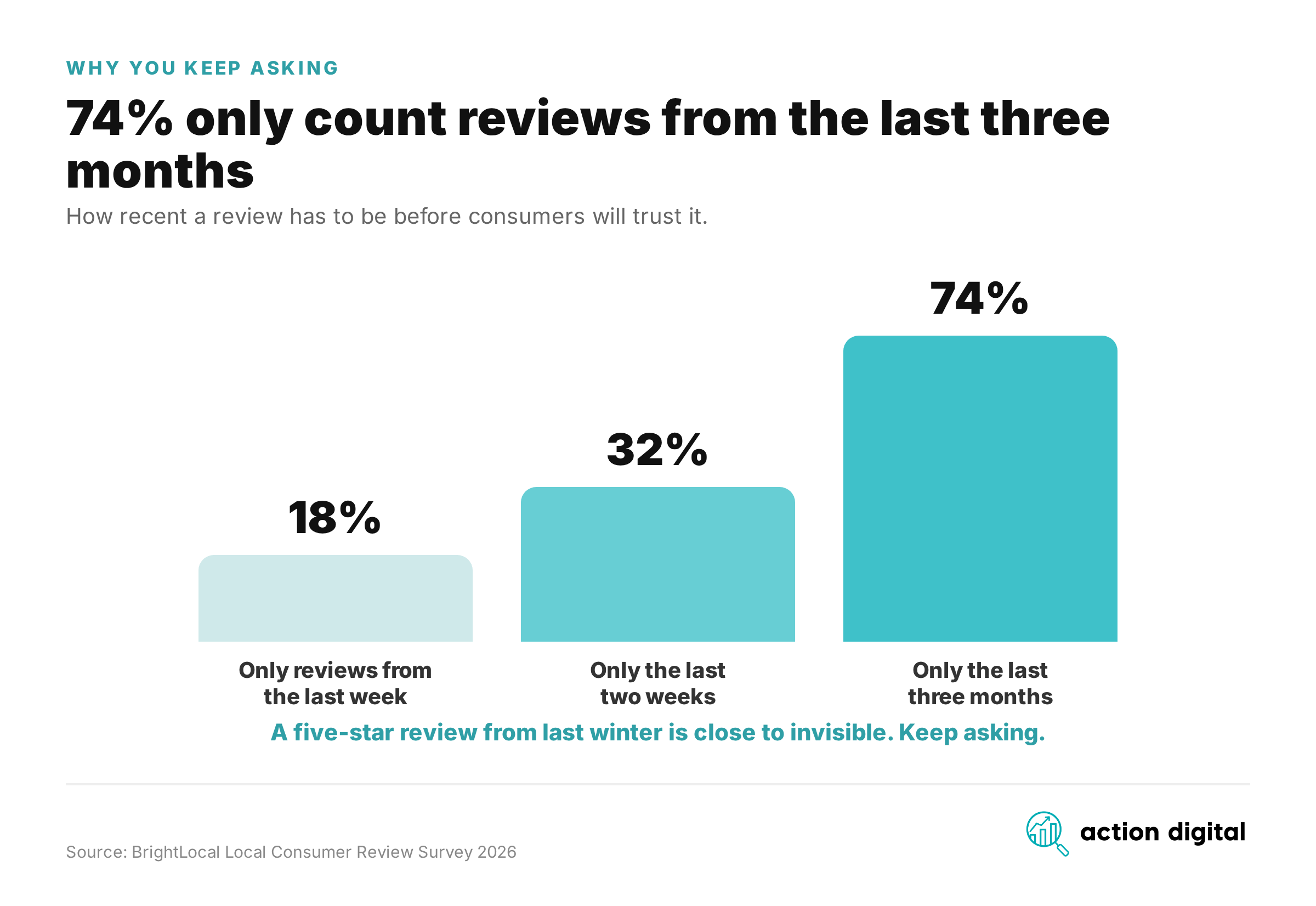
The recency numbers are the whole argument. If three quarters of people only count reviews from the last three months, a review profile is not an asset you build once. It is a tap you leave running.
Which means asking has to be part of the job, not something you get around to. A few rules that hold up:
Ask at the moment of the win. The customer is happiest when the job is finished, the site is clean and they can see the result. Not three weeks later when the invoice lands.
Ask everyone, not just the happy ones. Filtering out unhappy customers before you send a review request is called review gating and it breaks Google's policy. It is also unnecessary. A profile of nothing but flawless five-star reviews reads as fake to a lot of people.
SMS beats email for trades. A text with a direct link, sent while you are still in the driveway, gets answered. An email sent that evening gets buried.
Never pay for reviews. No discounts, no free upgrades, no entry into a draw. Google's review policy prohibits incentivised reviews and both the review and your profile are at risk.
Make it one tap. Use your Google review short link, put it in the SMS, and do not ask people to hunt for your profile.
If you want the longer version of this, we wrote a full guide on how to get more positive reviews to boost your local SEO.
What replying actually does, and what it does not
This is where most articles on this topic overreach, so let us be precise.
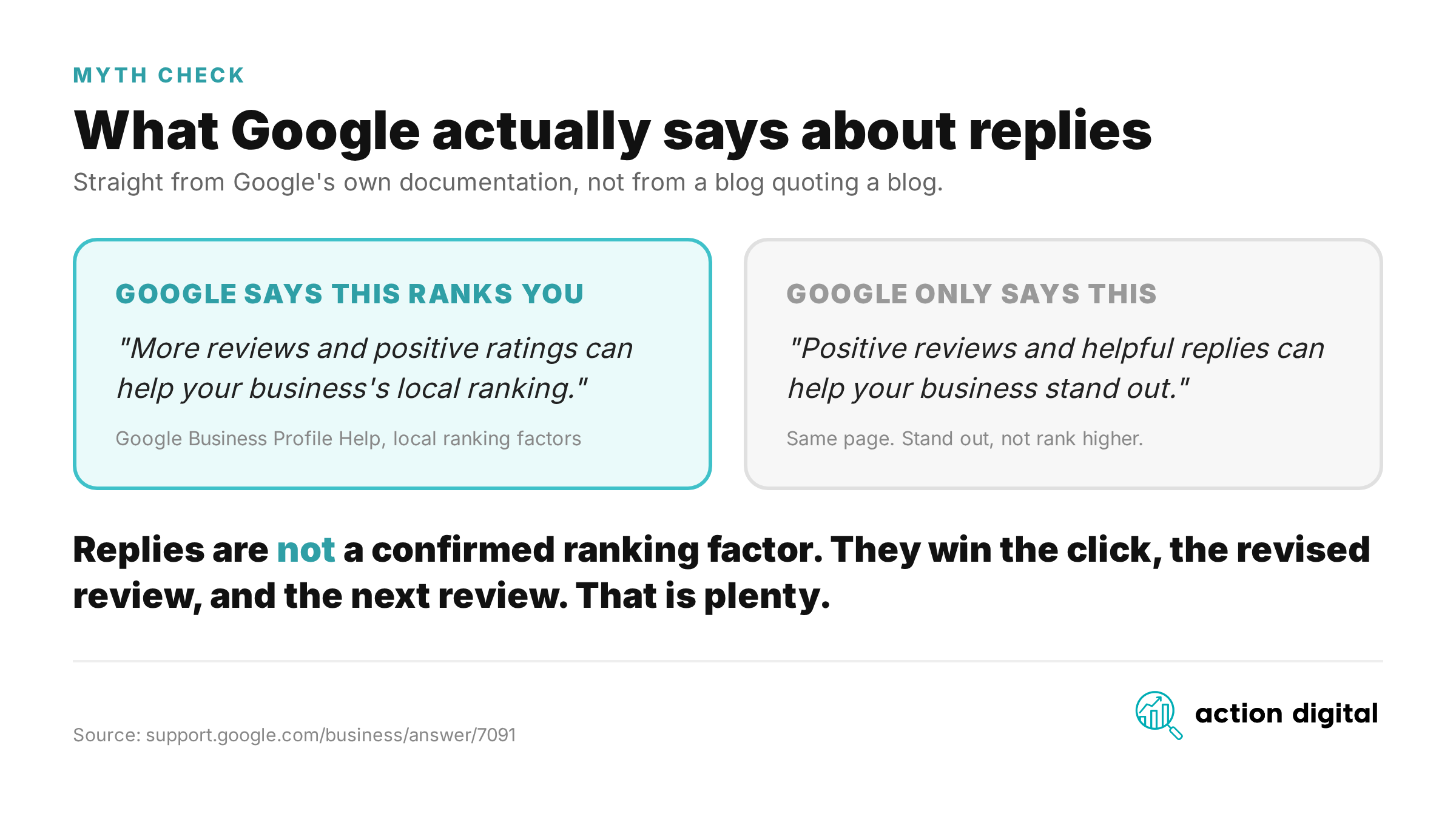
Google's own local ranking documentation says local results are based on relevance, distance and prominence, and under prominence it says: "More reviews and positive ratings can help your business's local ranking." That is a direct statement. Review count and rating feed ranking.
On replies, the same page says something different: "When you reply to customer reviews, it shows that you value their feedback. Positive reviews and helpful replies can help your business stand out."
Stand out. Not rank higher. Google has never said replies are a ranking factor, and anyone selling you a review-reply service on the promise of rankings is selling something Google explicitly says does not exist ("There's no way to request or pay for a better local ranking").
So what does replying actually do?
It converts. The person reading your profile is mid-decision. A calm, specific reply under a complaint is often the thing that keeps them on your listing instead of the next one.
It gets more reviews. People who see an owner replying are more likely to bother leaving one themselves, and more reviews and better ratings do feed ranking.
It saves the odd bad review. A reviewer who feels heard will sometimes revise or update their rating. Nobody who is ignored ever does.
It keeps the profile looking alive. A profile where the last owner activity was in 2023 tells a story, and it is not a good one.
Indirect is still real. It is just not magic, and we would rather tell you that than sell you a myth. If you want the ranking side done properly, that is what our local SEO work is for, and the complete guide to optimising your Google Business Profile covers the rest of the profile.
How to reply: four situations
Google moderates replies, and its policies apply to what you write as much as to what customers write. Across every reply: no personal details the reviewer did not share themselves, no discounts or refunds offered in public, never ask someone to change or remove their review, and never post the same reply twice.
The five-star review
Do not just say thanks. Name the person, name the job, and add one specific detail. It reads as real and it quietly tells the next reader what you actually do.
"Thanks Sarah. That split system in the back room was a tricky spot to get to, so glad it's running well through the heat. Give us a yell if you need the filters checked before summer."
The three-star review
The most valuable review you will get, because it usually tells you exactly what to fix. Thank them, acknowledge the specific gap, say what you have changed.
"Appreciate the honest feedback, Dave. You're right that we were later than the window we gave you, and that's on us. We've changed how we book the afternoon runs so it doesn't happen again. Thanks for the work."
The one-star review
Wait an hour. Check your records. Then keep it short, calm and factual. Acknowledge the experience, apologise for the experience rather than admitting to something you may not have done, and move the detail offline.
"Hi John, I'm sorry the install didn't go the way you expected. That's not the standard we work to. I'd like to get the details and sort it out. Can you call me on 0400 000 000 and ask for Mak?"
What kills you here is arguing. You may well be right. The next reader does not care who was right, they care how you behave when things go wrong.
The fake or mistaken review
It happens, especially to trades. Report it to Google under their prohibited content policies, and while you wait, reply once, publicly and calmly: state that you have no record of this person as a customer and invite them to contact you directly if you have the name wrong. Do not accuse them of anything. Then leave it alone.
The ten minute a week system
The reason most businesses do not reply is not that they do not want to. It is that replying means logging into a Google account someone set up years ago, on a desktop, while everything else about the business happens on a phone.
Fix the access problem and the habit follows. There are three ways to do it:
Google Business Profile Manager, on desktop, if you like doing it all in one place.
Your Business Profile directly in Google Chrome, by searching your own business name while signed in. Fastest option if you only have one or two reviews to answer.
One inbox that catches every review, which is how we set it up for our clients. Every new review lands in the same place as your calls, texts and enquiries, you reply from your phone, and it posts to Google. An AI assist reads the review and drafts a reply about that specific job, which you edit and send in seconds. More on that below.
That third option is part of the business platform we run for clients, built on GoHighLevel. It is also where the review requests get sent automatically after a job is marked complete, which solves the asking half of the problem at the same time. If you want the wider picture on protecting your name online, start with online reputation management.
Watch it done (2 short videos)
Rather than describe the clicks, here are two walkthroughs. The first covers desktop: replying inside Google Business Profile Manager, replying straight from your Business Profile in Chrome, and doing it from the one inbox in our platform. The second covers doing the same thing on your phone.
Desktop walkthrough
Mobile walkthrough
If you can do it from the driveway before you drive off, it gets done. That is the whole trick.
Where AI helps, and where it makes it worse
Half your future customers are put off by a reply that sounds copy-pasted. That does not mean you have to write every reply from scratch at 9pm. It means the reply has to sound like a person who was actually on the job.
That is the difference between a template and AI. A template says the same thing to everyone. Good AI reads the actual review and drafts a reply about that specific job, that specific name, that specific complaint, in your tone of voice. You read it, adjust a word or two, send.
In the platform we run for clients, the AI drafts the reply the moment the review lands, and you approve or edit it from your phone. It is the fastest honest way to do this:
Feed it the detail. The review mentions a leaking hot water system in Kingscliff on a Sunday, the reply should mention it too.
Set your tone once. Blunt, warm, formal, whatever you actually sound like. Then it stays consistent across every reply.
Always read before you send. Never let it apologise for something that did not happen, never let it discuss a customer's private details, never let it offer a discount you did not authorise.
Use it hardest on the tough ones. A calm reply to a one-star review is the hardest thing to write when you are annoyed. This is where AI earns its keep.
Used that way, AI is not the thing that makes your replies generic. It is the thing that finally makes them personal, because you actually get them done.
The short version
Ask every customer, every job, straight away. Recency is what counts.
Reply to every review, not just the good ones or just the bad ones.
Personalise every reply. Use AI to draft it fast, then edit it so it sounds like you. A template is worse than useless to half your audience.
Reply within a week, ideally the same day.
Say what Google says: replies help you stand out, reviews and ratings help you rank.
Ten minutes a week. It is the cheapest marketing you will ever do, and it is sitting there right now with a "reply" button next to it.
Want this running on autopilot, with review requests going out after every job and replies handled from your phone? Book a time with us and we will set it up.


