
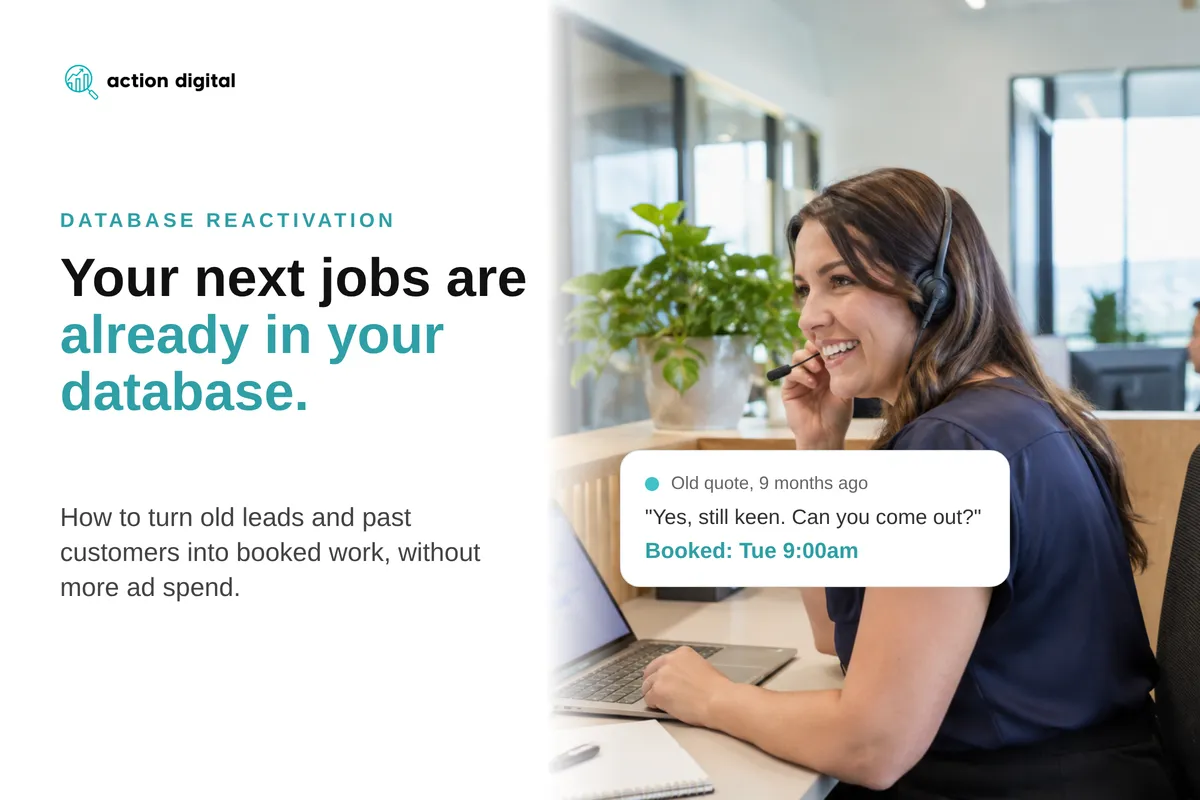
Database Reactivation: How to Turn Old Leads Into New Jobs
Somewhere in your phone, your inbox or your CRM, there's a list of people who once put their hand up.
They asked for a quote. They booked once and never came back. They filled in a form, got busy, and forgot about you.
You already paid to get every one of them. Most businesses never speak to them again.
That list is a database. Database reactivation is the process of waking it up and turning those contacts into booked jobs, without spending another dollar on ads.
The short version
- The money is already in your database. Old leads and past customers are warmer and cheaper to convert than cold traffic.
- Existing customers are far easier to sell to. A widely used benchmark puts the chance of selling to an existing customer at 60 to 70%, against 5 to 20% for a new prospect.
- Each group needs its own message. Past customers, old quotes and never-contacted leads are different conversations.
- "Just checking in" doesn't work. A clear, relevant offer with a real reason to reply now does.
- Replies need fast follow-up, or the lead goes cold all over again.
- Consent matters. In Australia, the Spam Act decides who you can text or email.
Why your old leads are worth chasing
Most businesses put all their effort into new leads. More ads, more clicks, more forms.
Meanwhile the people who already know them sit untouched. These contacts are usually:
- Warmer than cold traffic, because they've already heard of you
- Cheaper to convert, because you've already paid to get them
- More likely to buy again, if they've bought before
- Easy to reach, because you already have their number or email
The often-quoted figures from the book Marketing Metrics put the probability of selling to an existing customer at 60 to 70%, compared with 5 to 20% for a new prospect. Research from Bain & Company, covered by Harvard Business Review, found that winning a new customer can cost 5 to 25 times more than keeping an existing one.
They're rough benchmarks, not promises. But the direction is clear: the people who already know you are your easiest wins.
Where the hidden revenue sits
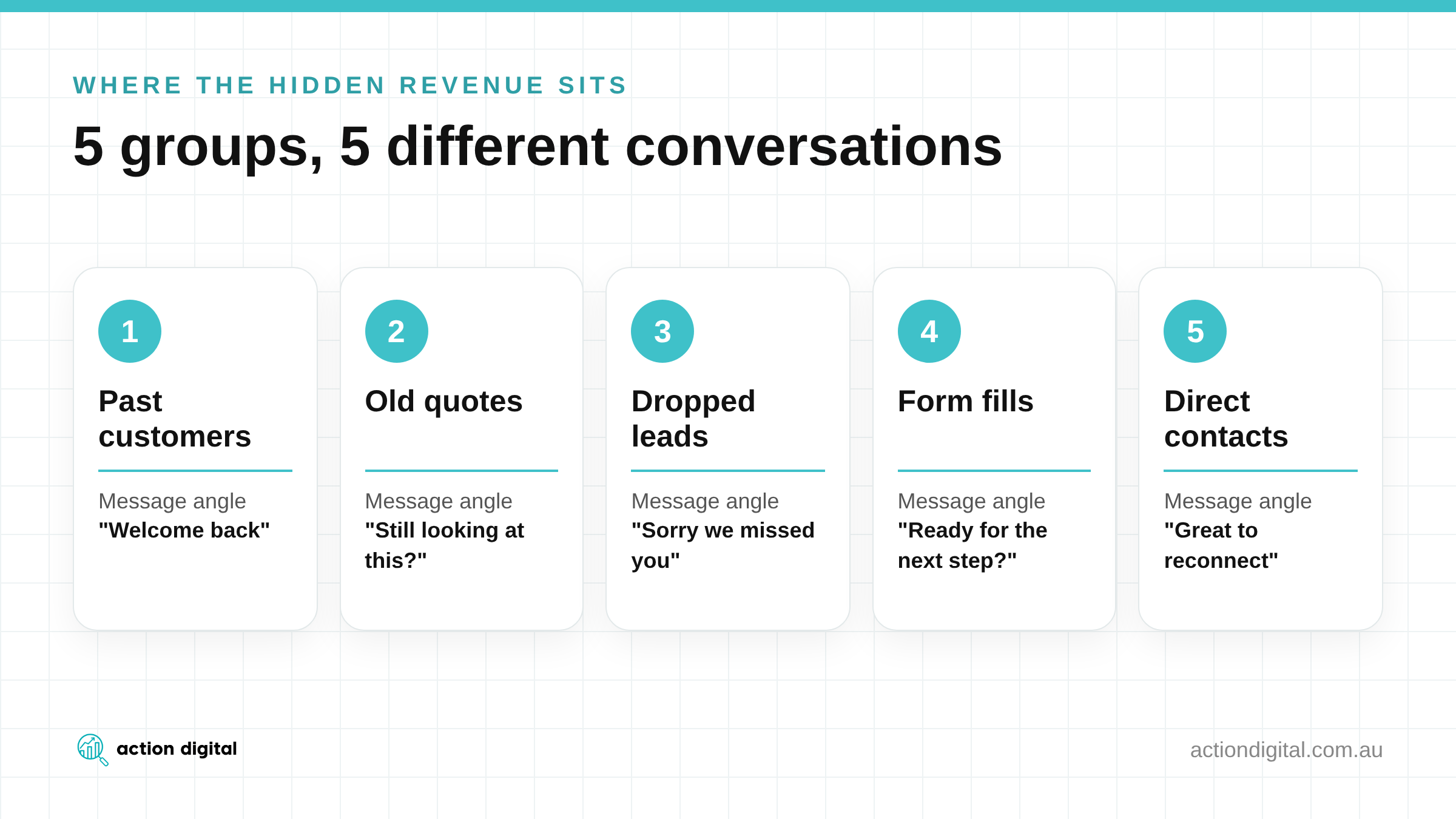
When we audit a business's contacts, the same groups turn up every time:
1. Past customers. They bought once and haven't been back. They trusted you enough to pay you, which is the hardest step.
2. Quotes that never closed. They were interested enough to ask for a price. Something got in the way: timing, budget, or nobody followed up.
3. Leads that were never contacted properly. The team was flat out, the enquiry landed in the wrong inbox, or nobody owned it. (We wrote about this in the jobs you never knew about.)
4. Form fills and downloads. People who grabbed a guide or registered for something but weren't ready to buy yet.
5. Direct contacts. Referrals, walk-ins, networking and phone calls that never made it into a follow-up process.
Each group needs a different message. A past customer gets a "welcome back". An old quote gets "are you still looking at this?". A lead you dropped gets an honest "we may not have got back to you properly".
What it could be worth
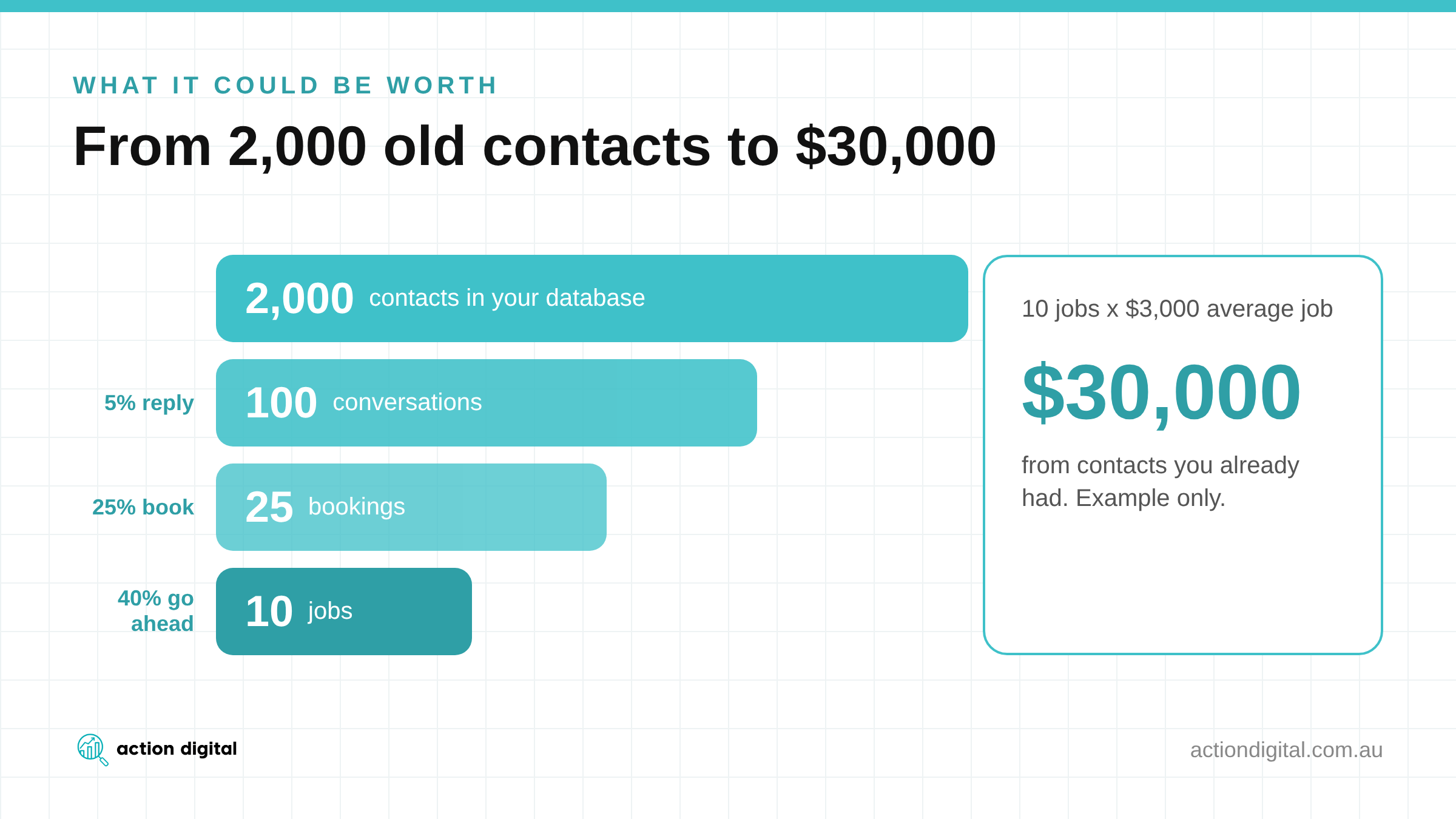
Here's a simple example for a local service business. Plug in your own numbers.
- 2,000 old leads and past customers in your database
- 5% reply to a reactivation campaign = 100 conversations
- 25% of those book a quote or appointment = 25 bookings
- 40% of those go ahead = 10 jobs
- 10 jobs x $3,000 average job = $30,000
That's from contacts you already had. And it doesn't count repeat work, referrals or the lifetime value of each customer you win back.
Why most reactivation attempts fail
Most businesses have tried something like this. A one-off email blast. A "Hi, just checking in!" text. Then nothing.
The root causes are nearly always the same:
- No structured follow-up process
- Contacts all lumped together, with no segmenting
- No offer, just "checking in"
- Nobody responsible for replying when people do respond
- No reporting, so nobody knows what it made
Your database gets treated like storage, not something that earns you money.
How a database reactivation campaign works
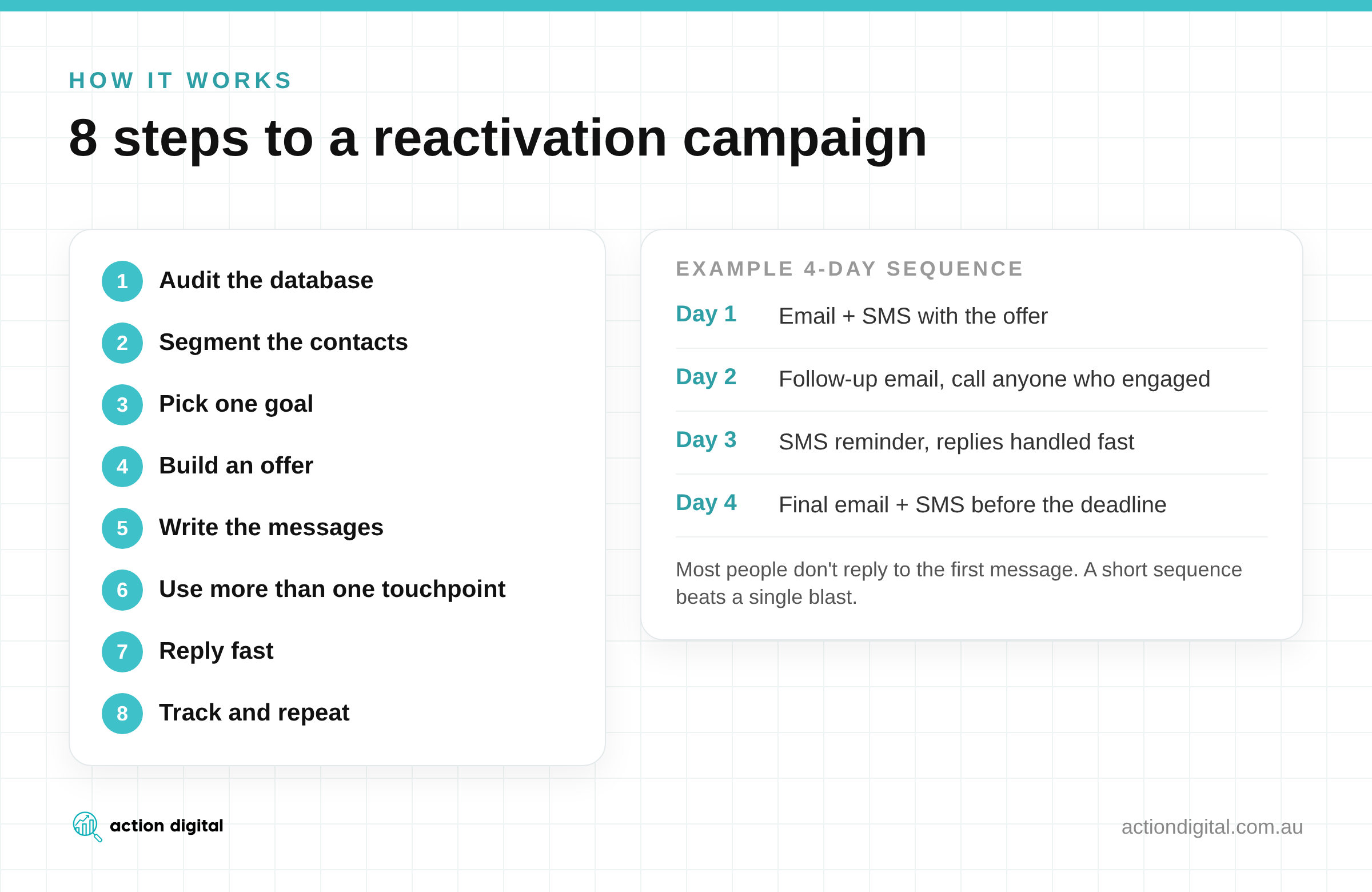
1. Audit the database. Pull everything into one place: your CRM, email list, phone contacts, old quotes and job records.
2. Segment the contacts. Split them into the groups above so each one gets the right message.
3. Pick one goal. Booked quotes, repeat jobs, a seasonal service or a win-back. One campaign, one goal.
4. Build an offer worth replying to. A clear outcome, a low-effort next step and a genuine reason to act now. "Checking in" doesn't create urgency. A strong offer does.
5. Write the messages. SMS, email and a short call script, with a reply ready for the most common answers.
6. Use more than one touchpoint. Most people don't reply to the first message. A short sequence over a few days works far better than a single blast. For example:
- Day 1: email and SMS announcing the offer
- Day 2: follow-up email, plus calls to anyone who engaged
- Day 3: SMS reminder, with replies handled straight away
- Day 4: final email and SMS before the deadline
7. Reply fast. When someone responds, get back to them within minutes, not days. This is where speed to lead matters most. An AI assistant can sort replies and book appointments, but it should support your team, not replace a real conversation.
8. Track and repeat. Measure replies, bookings, jobs and revenue. Then improve the message and run it again for the next group.
What a good offer looks like
The offer is the engine of the campaign. A few that work well for service businesses:
- Past customers: a priority booking window or a bonus add-on for returning customers
- Old quotes: "Prices are locked until Friday if you go ahead this week"
- Dropped leads: a free check, inspection or consultation to restart the conversation
- Seasonal: a reminder that ties to the time of year, like pre-summer servicing or end-of-year bookings
Keep any urgency real. If you say it ends Friday, it ends Friday.
Stay on the right side of the Spam Act
This is the part most businesses skip, and it matters. In Australia, commercial texts and emails are covered by the Spam Act 2003, which the ACMA enforces. In short:
- You need consent. Express consent (someone ticked a box or agreed to hear from you) is the safest.
- Inferred consent is narrow. The ACMA says it usually needs an ongoing relationship with your business, and marketing that's directly related to it. A one-off purchase or a single enquiry generally isn't enough.
- You can't text or email someone to ask for consent. That message counts as marketing too.
- Every message must say who it's from and how to contact you.
- Every message needs an easy, free unsubscribe, and you must action it within 5 working days.
So before you send anything, check how each contact got into your database and what they agreed to. Contacts without consent might be better handled with a phone call, or left out of the SMS and email side altogether. This isn't legal advice. If you're unsure, check the ACMA's guidance or get advice for your business.
Where to start
You don't need to message 2,000 people this week. Start with one group, like quotes from the last 12 months, one offer and one short sequence. Make sure someone is ready to reply fast.
If you'd like a hand working out what's sitting in your database and what it could be worth, book a time with Justin. We'll look at your contact groups, check what you can and can't send, and map out the quickest path to booked jobs.
Want to stop new leads going cold in the first place? Read the 3 systems every business needs to stop losing leads.
Sources
- Farris, Bendle, Pfeifer and Reibstein, Marketing Metrics (Wharton School Publishing, 2006)
- Amy Gallo, "The Value of Keeping the Right Customers", Harvard Business Review (2014)
- ACMA, Avoid sending spam


