
Never Miss a Lead: What a Proper Follow-Up System Looks Like
It's 10:15 on a Saturday. Your showroom is busy, two salespeople are with customers, and a new enquiry lands in the inbox.
Someone sees it. Nobody replies, because everyone assumes someone else will.
By Monday, the customer has already booked a consultation with another business.
That's not an advertising problem. The ad did its job. What broke was everything after the enquiry.
"Never miss a lead" sounds like a promise to answer the phone. In practice, it means something much bigger: every enquiry has a record, every conversation has an owner, and every interested customer has a next step.
Here's what that looks like, from the first message to the sale.
The short version
A receipt isn't a conversation. "Thanks, we'll be in touch" confirms delivery. It doesn't help the customer move forward.
Speed starts the process. A useful response within 60 seconds is a practical target, not a guarantee of a sale.
Qualify, then book. Ask enough to understand what the person needs, then offer the right next step.
Give every enquiry an owner. Automation should support your team, not create another inbox nobody checks.
Follow up without pestering. Keep the conversation relevant and stop when someone declines or opts out.
Measure sales, not just replies. More conversations only matter if they turn into attended appointments and customers.
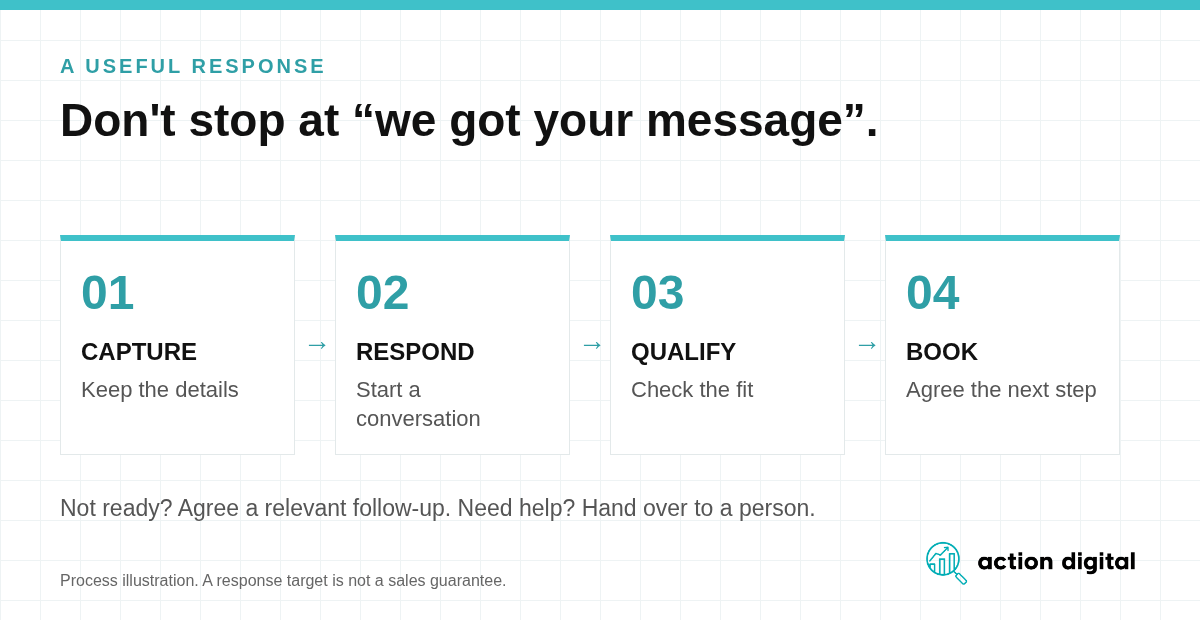
1. Capture the enquiry, wherever it starts
A customer doesn't care which channel your team prefers. They might call, fill in a form, message your Facebook page or walk into the showroom.
Your process needs to capture each of those enquiries and put the details somewhere the team can find them.
That doesn't mean you need a complicated setup. If enquiries currently live in a shared email inbox, start by making the basics visible:
Who enquired and how to contact them
What they're interested in
Where the enquiry came from
Who is responsible for it
What happens next, and when
A connected customer management system can keep these details together. The important part is that a lead can't disappear just because someone is off sick or a message gets buried.
For phone calls, decide what happens when the team can't answer. That could be a backup team member, a clearly identified AI receptionist, or a missed-call response that helps the caller take the next step.
2. Respond fast, with something useful
An instant "we've received your enquiry" email is better than silence. But it still leaves the customer waiting.
A useful response starts a conversation.
For example, an automated assistant could send this after a showroom enquiry:
Hi Alex, it's the automated assistant for Example Showroom. Thanks for asking about a kitchen consultation. Are you looking at a new build or a renovation?
That message identifies the business, makes the automation clear and asks one relevant question. It doesn't pretend a salesperson has personally reviewed the enquiry.
Aim to start that conversation within 60 seconds where the channel and setup allow it. If a person is available, let the customer speak to them.
Research supports taking response time seriously. In The Short Life of Online Sales Leads, Harvard Business Review reported that businesses attempting contact within an hour were nearly seven times as likely to qualify a lead as those waiting even an hour longer.
That's older US research about qualification, not a promise about Australian sales results. The practical lesson is simple: don't let a new enquiry sit untouched.
Our Speed to Lead system explains how voice and SMS assistants can help cover that first response.
3. Ask enough to send them to the right person
Fast replies aren't much use if every enquiry ends up in the wrong calendar.
Qualification is simply finding out what the person needs and whether your business can help.
For a showroom or sales-led business, that might mean asking:
What product or service are you looking for?
Where is the project?
Are you researching, comparing quotes or ready to book?
When would you like to get started?
Keep it conversational. One question at a time is usually more useful than a long questionnaire.
Agree the routing rules with your team before switching anything on. A standard consultation can go to a sales calendar. An existing customer's issue should go to support. A technical question, complaint or uncertain answer should reach a person.
An AI assistant shouldn't invent prices, promise delivery dates or guess whether a job is suitable. Give it approved information and a clear way to hand over.
4. Book the next step, not just another callback
"Someone will call you" creates another task. A confirmed appointment gives both sides something concrete.
Where it makes sense, offer available times for a consultation, showroom visit or quote appointment. Use the team's actual calendar availability, not a list of times that might still be free.
Then confirm:
The date, time and location, or call details
Who the customer will be meeting
Anything they need to bring or prepare
How to reschedule or cancel
Send a reminder before the appointment. If the person doesn't attend, give them a straightforward way to rebook.
The point isn't to fill the calendar at any cost. It's to get suitable people into appointments your team can actually deliver.
5. Keep a next step for the people who aren't ready
Not every good enquiry is ready to book today.
Some people need to speak to a partner. Some are waiting for building plans. Others asked for a quote and got distracted.
Without a follow-up process, all of those people look the same: silent.
Instead, record why they haven't booked and agree a sensible next step. Someone planning a project for next year doesn't need daily texts. Someone who asked for a call tomorrow needs that call tomorrow.
Follow-up can include:
An answer to the question that held them up
A helpful guide relevant to their project
A reminder about a quote they requested
A message at the time they asked you to reconnect
Stop automated sequences when the person replies, books, declines or opts out. Otherwise, they can receive "ready to book?" messages after they've already booked, which makes the whole experience feel careless.
In Australia, commercial SMS and email need appropriate consent, sender identification and an easy unsubscribe. A genuine reply to a requested enquiry isn't permission for an endless marketing sequence. Check the ACMA's guidance on avoiding spam before setting up ongoing campaigns.
6. Make the handover easy for your sales team
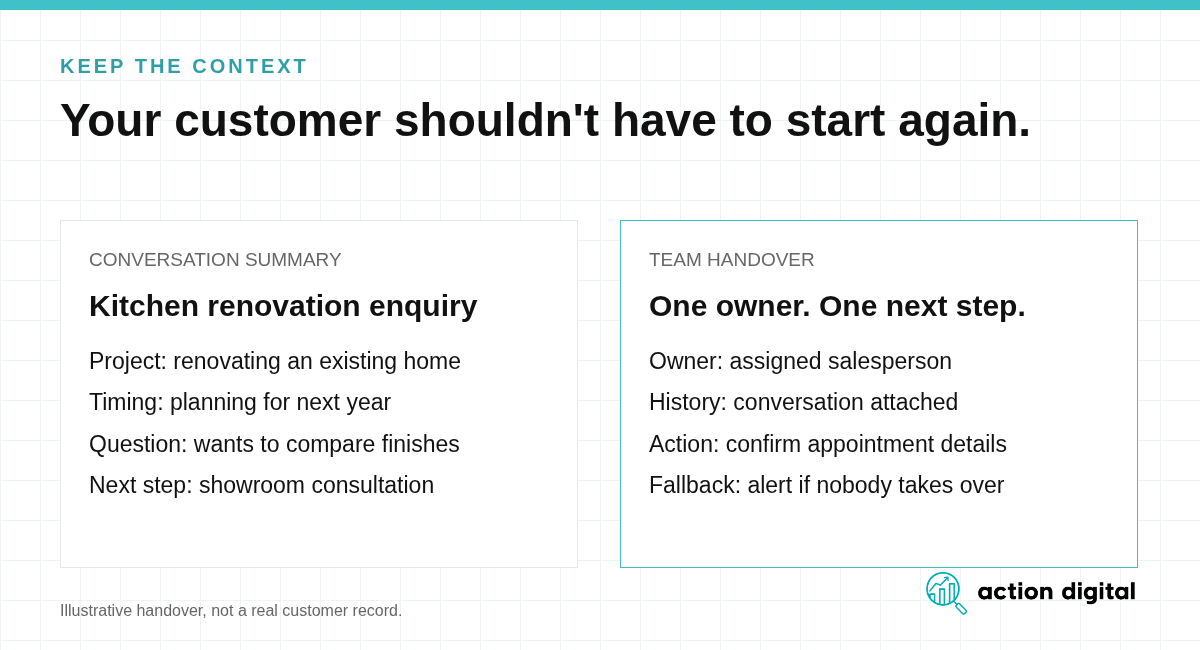
The customer shouldn't have to repeat everything when a salesperson takes over.
Give the team a short summary: what the person wants, their timing, the questions already answered and the agreed next step. Keep the conversation history available too.
Every open enquiry needs one named owner. If that person doesn't act within your agreed window, flag it for someone else.
And if the automation fails, the lead still needs attention. A failed text, broken calendar connection or unanswered question should create a visible exception, not quietly end the process.
This is where a system becomes useful: it helps the team do their work, rather than giving them another thing to monitor.
What better conversion could be worth
You don't need to double your leads to improve the result.
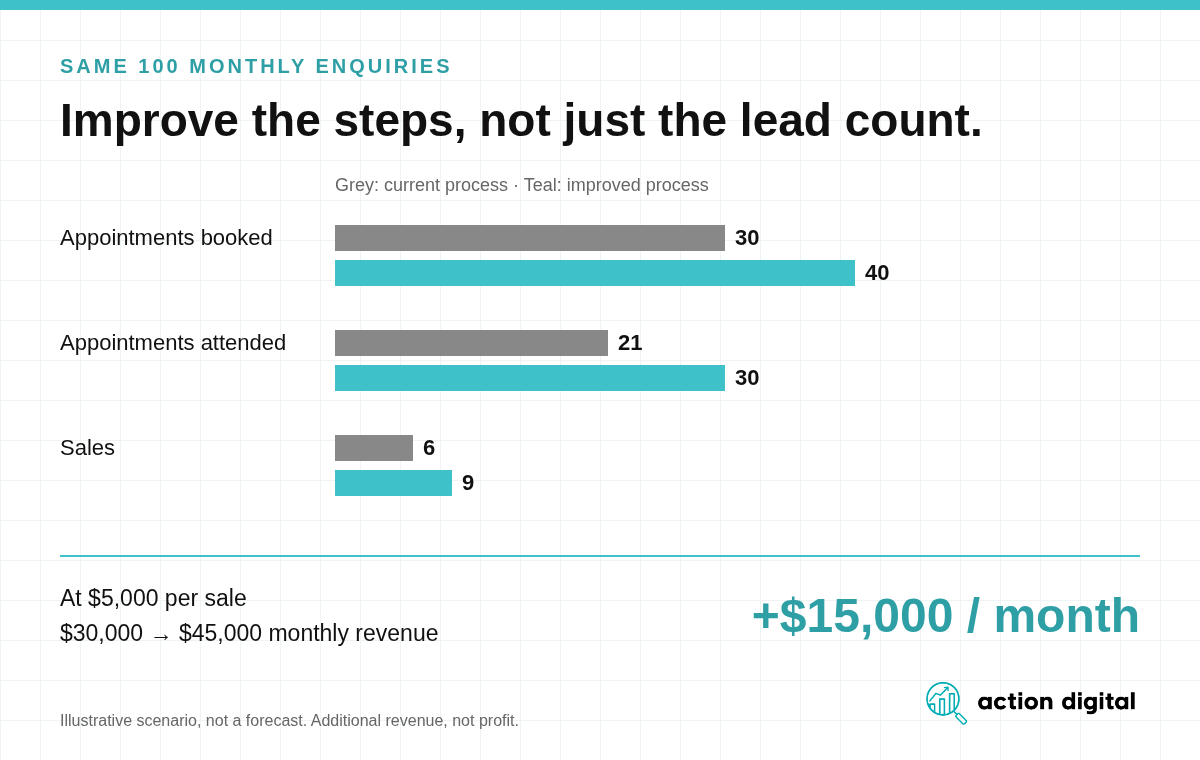
Here's an illustrative monthly example for a sales-led business:
Stage | Current process | Improved process |
|---|---|---|
Enquiries | 100 | 100 |
Appointments booked | 30 | 40 |
Appointments attended | 21 | 30 |
Sales | 6 | 9 |
Revenue at $5,000 per sale | $30,000 | $45,000 |
That's three extra sales, or $15,000 in additional monthly revenue, from the same number of enquiries.
Those are example numbers, not a forecast or a client result. Revenue isn't profit, and any extra sales still have delivery costs.
The useful part is seeing the stages separately. If people book but don't attend, work on confirmations and reminders. If they attend but don't buy, look at qualification and the sales conversation. Faster replies alone won't fix either of those problems.
Test your process before buying more leads
Pick your last 20 enquiries and ask:
Can we find all 20?
How long did each person wait for a useful response?
Did each enquiry have a named owner?
Did suitable customers get a clear next step?
Can we see who booked, attended and bought?
Do we know what happened to everyone else?
Then test your own form and phone number outside business hours. Check what the customer actually receives, not just whether a notification reaches your team.
You don't need to rebuild everything at once. Fix the point where the most enquiries are getting stuck, then measure what changes.
For the broader framework behind this approach, read the three systems that stop leads slipping through the cracks.
Find out where your leads are leaking
If your team is getting enquiries but too few are turning into appointments and sales, let's look at the process before you spend more on ads.
In a free Lead Leakage Assessment, we'll look at how enquiries arrive, how quickly they're answered and where the next step gets lost.


